READ

22 November 2024

On teaching in Iyengar Yoga: safe, accurate, transformative, profound

On teaching in Iyengar Yoga: safe, accurate, transformative, profound

B.K.S. Iyengar was a pioneer in introducing true didactics into the practice of Yog-asanas: the originator not only of props but also an innovator in questioning how he could transfer his expertise and knowledge to novice students. Over the years, his mode of teaching has evolved and, enriched by experience, the Iyengar method has been constituted as a discipline characterized by a specific mode of teaching, designed to ensure that students, of whatever constitution, age and health condition approach its practice, without risk.
The assumption is that the performance of the psycho-body practices typical of Yoga, Yog-asana and pranayama, must be correct in order to be beneficial and transformative. It was a few years ago (2013) that the disruptive book authored by two-time Pulitzer Prize winner W.J. Broad, “The Science of Yoga: The Risks and the Rewards,” presented some alarming statistics of injuries and accidents occurring in the United States during yoga classes. No sport or body discipline can be completely free of injury risks, not even the practice of asanas. However, the book-independently signed and based on a thorough investigation- correctly emphasized the widespread presence of teachers of dubious training and the need for users to be put in a position to know how to choose whom to trust. To the correct wake-up call sounded by Broad, the American Iyengar Yoga Association responded promptly by claiming the vanguard of the method and the professionalism of its certified teachers. In Italy, too, the current scenario of the sector has similarities with the American one, and the Italian Iyengar Yoga Association was the promoter and editor of the UNI standard on the Professional Figure of the Yoga Teacher to help newcomers orient themselves in the varied panorama of offerings.


Teaching risk-free yog-asana practice and helping students learn gradually, with accuracy, is our goal. The benefits obtained will be lasting and profound and the practice truly transformative. Precisely to ensure gradual learning for students, courses at Iyengar Institutes around the world are differentiated by levels. Starting this year, the Iyengar Yoga Institute in Milan introduces a small but significant novelty by articulating its training offerings from 3 to 4 levels differentiated by difficulty of the asanas and pranayama techniques taught (based on the syllabus of positions typical of Iyengar Yoga) and the instructions and actions required.


This is what they look like: to each his own level, but one method.


LEVEL 1 - INTRODUCTION
This course is intended for beginners up to 2 years of practice (1 year in case of biweekly attendance) of Yoga according to the IYENGAR® method. The aim of the course is to introduce the correct actions of feet, legs, shoulders and arms when performing asanas. Mainly standing asanas are performed and actions for performing seated, forward, backward and inverted stretching asanas are introduced. Through correct foot and leg work, arms and shoulders, the student learns to correct the position of the pelvis and his or her own posture, harmonizing the lumbar, dorsal and cervical spine tracts.
The work alternates between dynamic phases of mobilization and recovery of joint amplitudes and isometric work of stabilization and study of alignments.
The IYENGAR®Yoga teacher guides the student with precise instruction tailored to individual needs. The body becomes more active, sensitive and intelligent; the mind quiet and receptive. The course is preparatory to all sports disciplines and is recognized as a gymnastic sport activity aimed at health and fitness.
The postures taught and practiced are those of the Iyengar Introductory Syllabus I


LEVEL 2 - CONSOLIDATION
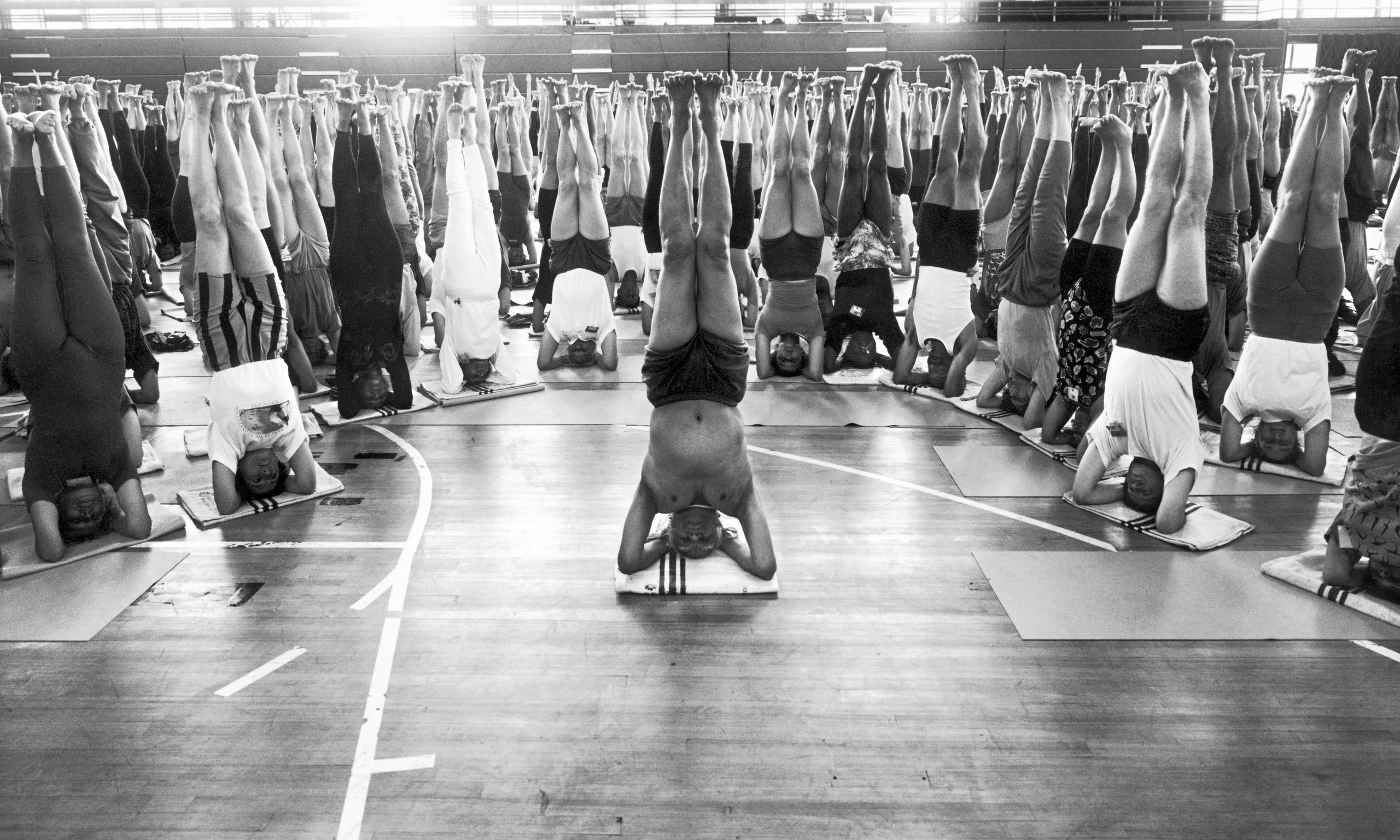
This course is intended for students with more than 1 year of regular practice of Yoga according to the IYENGAR® method. The objective of the course is to consolidate the correct actions of feet, legs, shoulders and arms, pelvis, and column while performing all groups of asanas: standing, forward and backward stretches, twists, inverted and supine postures. The correct actions introduced in the Level 1 course, enable the student to begin to tackle more complex postures without risk and to practice with the use of props. The practice of inverted postures (Sirsasana and Sarvangasana) is consolidated. The course also introduces breath observation and early pranayama techniques. The course is preparatory to all sports disciplines.
The postures taught and practiced are those from the Syllabus Iyengar Introductory I and II


LEVEL 3 - DEEPENING
This course is for students with an established practice who wish to further deepen their IYENGAR® Yoga practice. The goal of the course is to gain greater sensitivity, control and interoception by studying more precise and subtle actions in the practice of asana and pranayama.Students participating in this level should have a solid practice of standing postures, be able to perform the inverted postures Salamba Sirsasana and Sarvangasana, and be able to independently customize asanas through the use of props according to their needs. The course introduces more advanced actions in asana and pranayama and longer maintenance of asanas aimed at concentration and meditation.
The postures taught and practiced are those from the Syllabus Iyengar Introductory I and II and Junior I


LEVEL 4 - PERFECTING
This course is intended for experienced students who wish to perfect the practice of Yoga according to the IYENGAR® method. Students participating in this level should have an established practice of the postures of the Introductory I and II syllabuses, experience in pranayama, be autonomous in the use of props for their individual needs, and know the Sanskrit names of the asanas. The course introduces the study of the postures from the Intermediate Junior I-II-III syllabuses.
The postures taught and practiced are those of the Iyengar Introductory I-II Syllabus, Junior I-II-III


Bibliography


William J. Broad (2013). “The Science of Yoga: The Risks and the Rewards.”


UNI Standard 11661:2016, “Unregulated professional activities - Yoga teacher - Knowledge, skill and competence requirements”


Receive my free weekly newsletter

Sign up
Newsletter Icon
RELATED ARTICLES

Seasonality: the climate outside and the climate inside us

Transformation, ‘seasonality’, is a fundamental principle to be taken into consideration in personal yoga practice. Every day our embodiment experiences bio-chemical changes in order to adapt to external stimuli, generating an internal response and continuous transformation. In other words, every day we find ourselves dealing with a ‘climate outside’ and with a ‘climate inside’ us. In this series of four sequences I address this fascinating topic by proposing a practice for each climate season: Fall, Winter, Spring and Summer.

A 'virtuous evolution of the yoga market.

The spread of yoga in recent years has seen an astonishing acceleration, both nationally and internationally, culminating, emblematically, in United Nations General Assembly Resolution 69/31.

Breathing de-automatization: proper timing and proper results

"The body, the limbs, the psyche, the organs of action and sensory ones are very 'ours'.
Breathing is not as much "ours". However, breathing is more than anything else 'for us'."
Prashant Iyengar, "Pranayama: a Classical and Traditional Approach"